A new study by László Lőrincz, Brigitta Németh and Tamás Felföldi, published in Quantitative Science Studies, examines workplace conflicts in academia and how these relate to gender and researchers’ positions in collaboration networks.
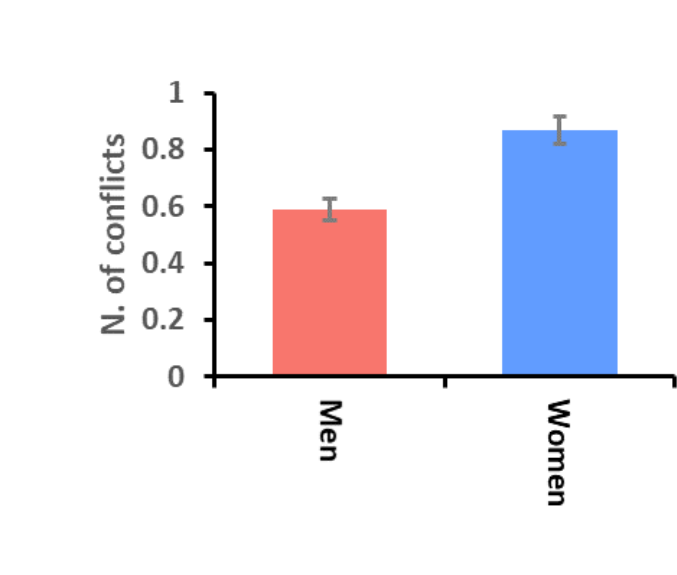
The academic sector is not different from other workplaces in the sense that conflicts exist. However, based on a survey developed by the Hungarian Young Academy, linked to administrative scientometric records, the authors find that women experience these conflicts significantly more frequently than men.
They also find that acting as a broker between different research communities is associated with more conflicts for women, while this relationship is not observed for men. Brokerage — connecting otherwise less-connected groups — is generally associated with access to diverse knowledge and can promote scientific careers. The results therefore suggest that this potentially advantageous network position may come with higher interpersonal costs for women in academia.
The study also shows that women report fewer conflicts in scientific fields where women are better represented, although the evidence that gender composition changes the relationship between brokerage and conflict is more limited.
Overall, the findings highlight that the benefits and costs of collaboration networks are not necessarily socially neutral: similar network positions may have different interpersonal consequences for women and men.
Read the full article:
László Lőrincz, Brigitta Németh & Tamás Felföldi: Gendered collaboration networks and their consequences on conflicts between academics, Quantitative Science Studies.
https://direct.mit.edu/qss/article/doi/10.1162/QSS.a.513/139757/Gendered-collaboration-networks-and-their