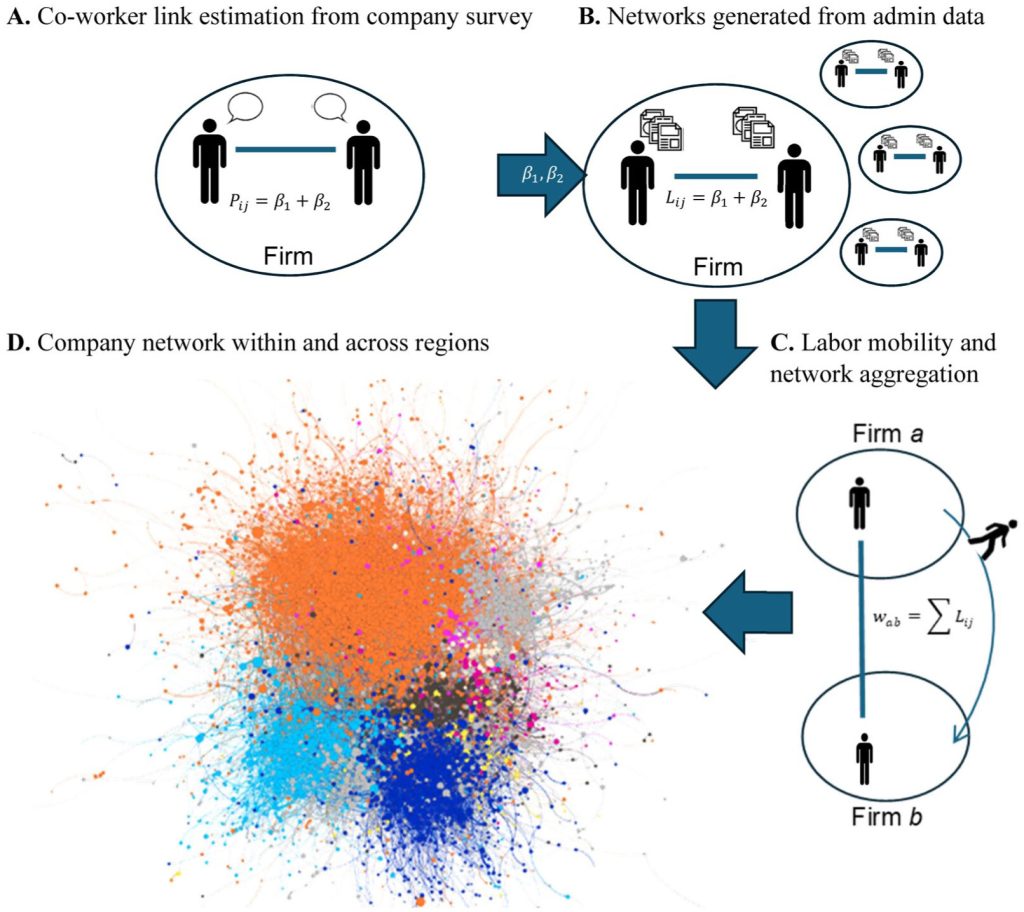
The study focuses on Sweden’s ICT sector and combines survey data on workplace relationships with nationwide administrative employer–employee data. The researchers use these data to model how professional relationships formed within workplaces can persist after employees change jobs, creating connections between firms over time.
One of the central findings is that the value of employee mobility goes beyond the direct transfer of knowledge when somebody joins a new company. Firms are also connected through lasting relationships between former co-workers — even when the companies themselves have never directly exchanged employees. These indirect social connections are associated with stronger firm performance, highlighting an often invisible channel through which knowledge can circulate between companies.
The study also shows that the value of networks depends on the type of firm and its regional environment. Smaller firms benefit particularly from diverse networks that provide access to different sources of knowledge. Inter-regional connections are especially valuable for smaller and established firms, while larger firms tend to benefit more from cohesive networks. Local connections become particularly important in growing regional clusters, where specialised knowledge is increasingly concentrated.
These results add an important social dimension to our understanding of regional clusters. Geographic proximity alone does not automatically generate knowledge exchange: the relationships people develop at work, and maintain as their careers evolve, can form a lasting infrastructure connecting firms and regions.
The findings also suggest that there is no single optimal networking strategy for all companies. Smaller firms may gain more from building bridges beyond their immediate environment, while larger firms can benefit from stronger local relationships and the coordination and trust they support.
Details of the article:
Social network benefits for cluster firms: A co-worker mobility approach
Balázs Lengyel, László Lőrincz, Guilherme Kenji Chihaya and Rikard Eriksson