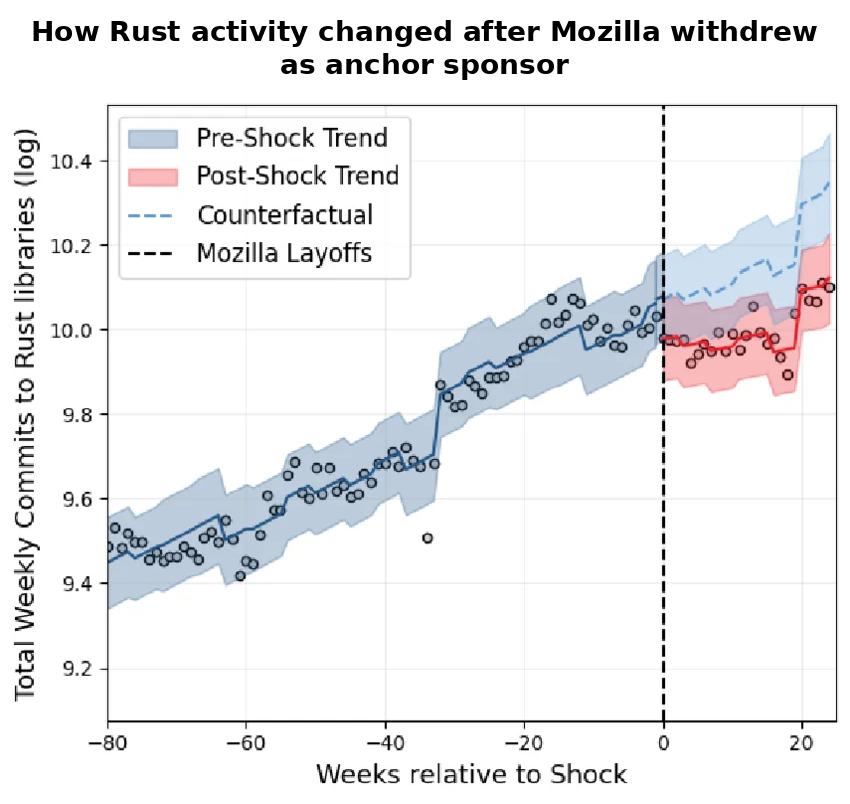
The authors study the Rust programming language ecosystem following Mozilla’s restructuring in 2020, when the company laid off many employees working on Rust. Using data on nearly 30,000 developers and 40,000 open-source projects between 2015 and 2022, they trace how participation changed after the shock.
The study finds an immediate decline of around 9% in weekly code contributions, followed by a slower growth trajectory. But the effects were highly uneven.
Developers who had worked for Mozilla, or were closely connected to Mozilla contributors, were relatively resilient. More distant contributors reduced their activity more substantially, and the ecosystem also saw fewer new developers and new projects entering after Mozilla’s exit.
The findings suggest that a major corporate sponsor does more than provide resources. Its presence can also signal stability, quality and future prospects, especially to people who are not yet deeply embedded in the community.
This creates an important tension in open-source ecosystems: they may be decentralized in participation, while still depending on a small number of influential firms whose decisions can shape the confidence and engagement of the wider community.
Publication
Brigitta Németh and Johannes Wachs, Anchor sponsor firms in open source software ecosystems: A case study of the Rust ecosystem, Technological Forecasting and Social Change.
Read the article on ScienceDirect:
https://www.sciencedirect.com/science/article/abs/pii/S0040162526004130